You Won’t Believe How Ancient Stones in Olympia Tell a Whole Story
Walking through Olympia, Greece, I was stunned by how the ruins rise from the earth like whispers of a lost world. The architectural style isn’t just old—it’s alive with meaning. From the Temple of Zeus to the stadium’s worn stones, every structure tells a story of power, religion, and human ambition. If you’re into history that feels real, not staged, this place will blow your mind. I never expected ancient limestone and marble to move me so deeply. The silence between the columns, the way sunlight falls across weathered steps—it’s as if time itself has paused to let us listen. This is not a museum display behind glass; it’s a living landscape shaped by belief, discipline, and beauty. And once you begin to read its language, the stones start speaking.
Arrival in Olympia: First Impressions That Stick
As visitors step through the entrance of the archaeological site at Olympia, they are immediately met with a sense of order and intention. Unlike the haphazard growth of modern towns, the layout of ancient Olympia was carefully planned to reflect both spiritual reverence and civic function. The sacred precinct known as the Altis forms the heart of the sanctuary, enclosed not by walls but by an invisible boundary defined by tradition and design. Within this grove, temples, altars, and treasuries were arranged not for symmetry alone, but to guide movement and focus attention on what mattered most—worship, competition, and communal identity.
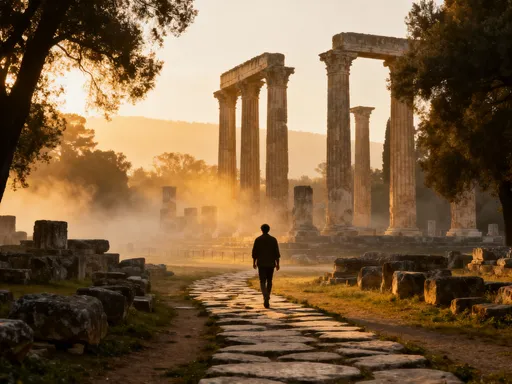
The stone pathways that weave through the site do more than connect buildings—they create a rhythm, a progression that shapes the visitor’s experience. You don’t simply walk from point A to B; you follow a sequence that builds anticipation and reverence. The path leads naturally from the Propylaea, the monumental gateway, toward the Temple of Hera and then onward to the Temple of Zeus. This deliberate flow reflects the Greek ideal of kosmos—order emerging from chaos. Even without a guidebook, one begins to understand that this was not merely a place of sport or ritual, but a carefully orchestrated environment where architecture served higher purposes.
What strikes many first-time visitors is how open and uncluttered the space feels. There are no towering reconstructions or modern additions to distract the eye. The ruins stand in their authentic state, allowing the imagination to fill in the gaps. Grass grows between cracked flagstones, trees shade ancient foundations, and the Alpheios River murmurs nearby. It’s a place where nature and human creation coexist in balance. For women in their thirties to fifties who seek meaningful travel experiences—those who value depth over spectacle—Olympia offers something rare: authenticity. You feel the presence of history not through dramatized reenactments, but through quiet observation and reflection.
The Temple of Zeus: Power Carved in Stone
Dominating the sanctuary, the Temple of Zeus remains one of the most powerful expressions of ancient Greek architecture. Though only six of its original columns still stand, their massive scale conveys the grandeur that once defined this sacred space. Built in the Doric style during the 5th century BCE, the temple was constructed using local limestone, with each column composed of stacked cylindrical drums covered in fine stucco to mimic polished stone. These columns were not merely structural—they embodied mathematical precision and symbolic meaning.
The temple’s design follows strict proportional rules. The spacing between columns, the height of the entablature, and the ratio of width to length all reflect a deep understanding of harmony and balance. Even the slight curvature of the stylobate—the platform on which the columns rest—was engineered to correct optical illusions, ensuring the building appeared perfectly straight to the human eye. This attention to detail was not just technical; it was philosophical. The Greeks believed that beauty arose from order, and order reflected the divine structure of the universe.
Inside the temple once stood the chryselephantine statue of Zeus, crafted by the master sculptor Phidias—the same artist responsible for the Athena Parthenos in Athens. This statue, made of gold and ivory over a wooden frame, was one of the Seven Wonders of the Ancient World. Though it no longer exists, historical accounts describe a figure so awe-inspiring that visitors fell to their knees in reverence. The platform on which it stood measures over 20 meters long, a silent testament to its former magnificence. The temple faced east so that morning light would stream through the doorway, illuminating the statue’s face at dawn—a deliberate alignment connecting the god with the rising sun, symbolizing renewal and eternal power.
For modern travelers, especially those interested in how architecture can convey spiritual ideals, the Temple of Zeus offers a profound lesson. It was not built for show, but to inspire awe and reinforce belief. Every element—from the triglyphs above the columns to the metopes depicting the Labors of Heracles—told stories that reinforced cultural values. Standing beneath those remaining columns today, one can almost feel the weight of devotion that once filled this space. It’s a reminder that great buildings do more than shelter—they elevate the soul.
Stadium and Training Grounds: Function Meets Form
Just beyond the sacred Altis lies the ancient stadium of Olympia, a simple yet powerful structure carved directly into the natural slope of the hillside. Unlike the elaborate amphitheaters of Rome, the Greek stadium was built with minimal intervention—no artificial seating or vaulted corridors. Instead, spectators sat on earthen banks covered in grass, forming a U-shaped arena that could accommodate up to 45,000 people during the Olympic Games. There was no roof, no shade, and no luxury seating—only the openness of sky and the shared energy of the crowd.
This simplicity was intentional. The Greeks valued clarity, visibility, and equality in athletic competition. All spectators, regardless of status, looked down upon the same field from similar vantage points. The track itself measured exactly 192 meters—the length of a stade, from which the word “stadium” derives. Runners competed on a packed clay surface, their feet pounding the same earth that athletes had raced on for over a thousand years. Today, visitors can walk along the starting line, touch the stone blocks with carved grooves for the sprinters’ toes, and imagine the roar of the crowd echoing across the valley.
Nearby, the remains of the gymnasium and palaestra reveal the spaces where athletes trained in the days leading up to the Games. The gymnasium was a long colonnaded hall surrounded by rooms for exercise, bathing, and instruction. Its shaded walkways provided relief from the summer sun while allowing coaches to observe and guide their pupils. The palaestra, a square courtyard surrounded by porticoes, was used primarily for wrestling, boxing, and other combat sports. These were not just functional spaces—they were designed with proportion and balance in mind, reflecting the Greek ideal of arete, or excellence in body and mind.
What makes these training grounds particularly meaningful for today’s travelers is how they connect physical discipline with moral development. In ancient Greece, athletic training was not separate from education—it was part of it. Young men learned self-control, endurance, and respect through sport. The architecture supported this philosophy: open courtyards encouraged observation and community, while colonnades offered quiet spaces for reflection. For women who appreciate the deeper dimensions of travel—those who seek not just sights but insights—Olympia’s sports complex offers a rare glimpse into a culture that saw the body as a vessel for virtue.
Material Choices: Why Limestone and Marble Mattered
The materials used in Olympia’s construction tell a story of evolution, resourcefulness, and cultural pride. In the earliest phases of building, local limestone was the material of choice. Easily quarried from nearby hills, it was relatively soft and simple to shape with bronze and iron tools. Structures like the Temple of Hera, one of the oldest in the sanctuary, were built entirely of this durable yet workable stone. Over time, however, builders began to replace limestone elements with marble, particularly from quarries on Mount Pentelicus and other regional sources. This shift was not merely aesthetic—it signaled growing wealth, technological advancement, and a desire for permanence.
Marble offered several advantages. It was harder, more resistant to weathering, and could be polished to a luminous finish. When used for columns, capitals, and sculptural details, it gave buildings a refined elegance that limestone could not match. The transition from limestone to marble also reflected increasing confidence in engineering techniques. Builders mastered subtle refinements such as entasis—the slight outward curve of columns—which prevented them from appearing too thin or weak when viewed from a distance. This optical correction demonstrated both technical skill and artistic sensitivity.
Roofing materials also evolved over time. Early temples had wooden beams and tiled roofs, vulnerable to fire and decay. Later reconstructions incorporated marble tiles and stone lintels, improving durability. Even the stucco coating applied to limestone surfaces was formulated to withstand moisture and temperature changes, preserving the appearance of the buildings for generations. These decisions were not made in isolation—they responded to environmental conditions, available resources, and changing cultural values.
For the thoughtful traveler, understanding these material choices adds depth to the experience of walking among the ruins. Each stone carries a message about the people who selected it, shaped it, and placed it with care. It’s a reminder that architecture is never neutral—it reflects priorities, beliefs, and aspirations. Seeing the contrast between early and later construction phases helps visitors appreciate how Olympia grew not just in size, but in ambition and sophistication.
Sacred Altis: Where Nature and Design Unite
At the center of Olympia lies the Altis, a sacred grove that was never meant to be a formal garden or manicured park. Ancient writers such as Pausanias described it as a place shaded by tall trees—olive, plane, and cypress—under which altars and statues stood like silent witnesses to centuries of worship. Unlike the rigid geometry of later Roman architecture, the paths through the Altis wind organically, inviting discovery rather than dictating movement. This blending of wild greenery and structured stone reflects the Greek belief that nature itself was divine, a manifestation of the gods’ presence on earth.
The placement of monuments within the grove feels deliberate yet unforced. Statues of gods, heroes, and victorious athletes were not arranged in neat rows but nestled among the trees, visible only when approached from certain angles. This created a sense of revelation, as if the landscape itself was guiding the visitor toward moments of insight. Some altars were built directly into tree roots, symbolizing the connection between earthly life and spiritual power. The Great Altar of Zeus, made of accumulated ash from centuries of sacrifices, rose like a natural mound within the grove—a monument formed not by masons, but by ritual itself.
This integration of architecture and nature stands in stark contrast to modern urban environments, where buildings often dominate the landscape. In the Altis, structures do not overpower the trees; instead, they coexist in harmony. Sunlight filters through leaves onto stone steps, birds nest in broken capitals, and vines climb ancient walls. For women who cherish balance in their own lives—between family, work, and personal growth—this harmony can feel deeply resonant. Olympia does not shout its significance; it whispers it, gently, through the interplay of shadow and light, stone and leaf.
Walking through the Altis today, one senses a different kind of sacredness—one not confined to temples or rituals, but woven into the very fabric of the place. It’s a reminder that holiness can reside not only in doctrine or dogma, but in the quiet beauty of a well-ordered space. The Greeks did not separate the divine from the everyday; they embedded it in their surroundings. And in doing so, they created a sanctuary that continues to inspire reverence more than two millennia later.
Practical Tips for Seeing the Architecture Clearly
To truly appreciate the architectural genius of Olympia, timing and preparation matter. The best time to visit is early in the morning, when the sun rises behind the stadium and casts long shadows across the ruins. These shadows highlight the textures of carved stone, reveal the subtle curves of columns, and emphasize the proportions that define classical design. Midday light tends to flatten surfaces, making details harder to see. By arriving at opening time, you also avoid crowds, allowing for a more meditative experience.
Wear comfortable walking shoes with good support. The terrain is uneven, with cracked pavements, raised foundations, and grassy slopes. Some areas require stepping over low walls or navigating narrow paths. A wide-brimmed hat and sunscreen are advisable, especially in summer months, as shade is limited in many sections of the site. Carrying a reusable water bottle is also recommended, as hydration stations are available but not frequent.
A printed site map or a downloaded offline version of the official guide can greatly enhance your understanding. Look for color-coded sections that indicate different construction phases—Archaic, Classical, Hellenistic, and Roman. This helps identify which buildings were original and which were added or rebuilt over time. Pay attention to floor plans displayed at key locations; they show how temples were oriented in relation to sunrise, seasonal solstices, or nearby landmarks.
Avoid relying solely on audio guides that focus only on myths and legends. While these stories are valuable, they often overlook the architectural intelligence behind the structures. Instead, observe how doorways align with celestial events, how columns taper upward to create visual balance, and how thresholds mark transitions between sacred and public spaces. Bring a small notebook and sketch what you see—even rough drawings help internalize proportions and design principles. If possible, visit the on-site museum before or after touring the ruins. Its collection includes fragments of sculptures, reconstructed architectural elements, and scale models that bring lost buildings back to life.
Why Olympia’s Style Still Matters Today
The legacy of Olympia extends far beyond archaeology. Modern architects, urban planners, and designers continue to study its principles of proportion, orientation, and human-centered space. The emphasis on balance, natural light, and harmonious flow remains deeply influential in contemporary design. Buildings that follow these ideals—whether public libraries, civic centers, or community parks—often feel more welcoming, calming, and purposeful. They don’t impress through size alone, but through the quality of experience they create.
Olympia teaches us that great spaces are not just functional—they are meaningful. The stadium wasn’t merely a venue for races; it was a stage for human achievement. The Temple of Zeus was not just a religious building; it was a symbol of cosmic order. The Altis was not just a grove; it was a living sanctuary where nature and spirit intertwined. These places were designed to elevate the human experience, to inspire awe, discipline, and connection.
For women who shape homes, raise families, and contribute to their communities, the lessons of Olympia are especially relevant. Creating a nurturing environment—whether in a house, a school, or a neighborhood—requires thought, care, and intention. The ancient Greeks understood that space shapes behavior, mood, and values. They built not for fleeting trends, but for lasting significance. In a world filled with noise and distraction, Olympia reminds us of the power of simplicity, order, and beauty.
Visiting Olympia is not just an act of looking at the past. It is an invitation to rethink how we design our present. The stones do not merely survive—they speak. They tell us that architecture can teach, heal, and inspire. And if we listen closely, we might just learn how to build not only better cities, but better lives.